Teaching in nice chewy chunks
Neuroathletics, embodiment, biomechanics, anatomy, training theory taught through the lens of circus arts (and maybe some fight sports examples). You learn the science in the context you already move in.
You want to know what your body is doing, and why.
You don't need to know anything already — just have curiosity to learn and a little kink for the human body and movement.
Self-paced. No prior science or training background needed.
69 Euros, lifetime access.
Less than one physio session costs to fix a training error.
A self-paced training science course for people who do circus arts.
Maybe you are a beginner, a hobbyist, or a semiprofessional. Either way, you already do movement and body.
And maybe you never learned about anatomy and biomechanics, so you don't really know what exactly you are training.
Or maybe you just copy moves and poses?
I tell you from experience: you want to know exactly what you are training. You want to know what your body is doing, and why. And how you do it cleanly, and what for you do it.
WHY?
You will progress faster, and have fewer injuries.
You will build a body that keeps showing up, for the long run.
Own the theory
You spent time on the mat, in the air, under the hoop.
You know how a trick feels when it works, and still you have probably spent whole seasons waiting for one shape to finally click.
So, what is actually missing?
Not effort. Effort and passion you probably have in abundance.
What is missing is the map: what the shape is made of, which piece of you builds it, and in what order those pieces come online.
You already have the practice.
You need the course.
This course and your practice create alchemy.
Neuroathletics, embodiment, biomechanics, anatomy, training theory taught through the lens of circus arts (and maybe some fight sports examples). You learn the science in the context you already move in.
Understanding your body and movement allows you to train at the edge without tipping over it, and that is what performative longevity actually needs.
The teachings follow the B.A.M.M. approach of What, How, Why, and What For. So nothing stays abstract, and everything lands in your next session.
Interoception, body scans, motor imagery, and a trauma-aware approach. Circus is a lot more than executing crazy skills, and your training should reflect that.
7 modules · 20+ hours of content · 170+ pages of text. Tap a module to open it.
Gives artists the underlying "why" behind balance and coordination cues, so corrections make sense instead of feeling like magic.
Unlocks faster skill acquisition and steadier performance under pressure by training the sensory system that decides how much strength and range the body allows.
Teaches artists to read their own nervous system, so training builds performance confidence, not just physical capacity.
Unpacks the single elements of training – in order to stop repeating tricks and start training the building blocks a pose or move is made of.
Gives artists a structured recovery toolkit so training gains actually stick instead of quietly overtraining.
Gives artists a concrete way to audit and upgrade wherever they train — a home corner or a full studio.
Helps artists build a smart home setup and use every piece of equipment with real purpose.
The course keeps growing, and the next stretch of material is already taking shape. For example:
Anatomy basics build the working vocabulary of the body, so a cue turns into something you can locate on yourself.
The motor skills part sorts the word fitness into separate trainable qualities and shows which quality a specific trick is asking for.
The basic position for training runs a ground-up checklist from the feet through pelvis, intra-abdominal pressure, shoulders and breath, since there is no isolated muscle and every exercise is a whole-body job.
From there the work moves into the big joints, hip and shoulder, into breathing and intra-abdominal pressure, ground reaction force, muscles and their function, torque, the types of strength, and the difference between mobility and stretching, with the positioning of feet, hip, core, shoulders, neck, wrists and rotation taken one at a time. And so on…
What you can take from this: you stop copying shapes and start reading your own body, dissecting the poses, building your training and exercises. How each single module will land is still open, and that is what a living course looks like from the inside.
The mat (every mat) is a dojo for life.
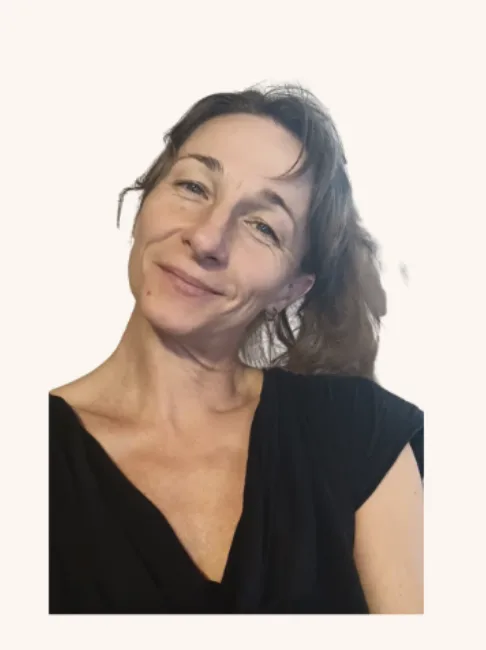
I plateaued for years by parroting poses. I practiced skills hard, I was committed, and still my body did not do what I wanted.
For example I never managed a handstand. I wanted to, but I couldn't. I tried for years. No f***ing way I could do a handstand.
Then I started training from an informed place, and the quality of my output changed tremendously. Handstands, inversions, arm balances, come out of my body now. I can follow my creative impulses because my body has vocabulary to express them.
That turn in training outcome is the thing I want to hand you! Hopefully several years earlier than I got it.
Thank god I have severe imposter syndrome. It made me become:
Personal trainer, currently in athletic trainer education, mobility trainer, certified psychological counselor, medical massage therapist, embodiment coach, yoga teacher, in education to become a circus trainer (and some more)
I also throw in the pot: years of kids and adults circus workshops, and a semiprofessional performer background with years as a street artist. And the profound understanding that the mat (every mat) is a dojo for life.
I trust you, teach meEvery module is related directly into circus relevant practice. Science, spoken in your own vocabulary, not delivered in generic gym examples.
You don't train a handstand — you do one. You train its building blocks — and theory is what teaches you the elements: where they come from, how to isolate them. Work on the elements, not the repetition.
You can find every piece of information in this course somewhere on the internet, disconnected and random. In contrary, this course is structured to be meaningful for you, your practice, and your development.
This course is a beta version.
What does that mean for you? It means you're getting in before this becomes the fully expanded version it's going to be — and you're getting in at a fraction of what it will cost.
Here's the deal.
Right now, the price is very, very low. Genuinely cheap for what's already inside (7 juicy modules, filled with more than 20 hours of content and more than 170 pages of text).
Because I'm still building this out, module by module, and I want the people who take a chance on me now — before it's all sexy and finished — to get the lowest price this course will ever have.
The more pressing reason: Because I need money now. Simple as that.
The more powerful reason: Because I know it will give me a tremendous boost to know there are already real humans working with my course.
To build such a course is extremely intense, and asks a shit load of focus, work, discipline. Building such a course comes with a ton of unexpected problems, complications, and tasks. Building such a course comes with a wild amount of personal growth, understandings, and gazillions of rabbit holes to dive into (and eventually get lost for 3 days in the topic of reflexes, or uncovering layer by layer the intra-abdominal pressure and being mesmerized by this mind-blowing thing) — and seemingly endless decision making.
Uff.
And to know someone is already benefiting from all this effort gives me energy, keeps me focused, gives me excitement and a right amount of arousal (once you went through the stress and training module, you know what arousal I refer to).
I know that when I do not produce my course into the void, but for real humans, the process of production will become for me lighter, more fun and more pleasurable.
So we have a win-win — you get an amazing course for cheap, I get some money and amazing motivation.
Because the full course will be available all at once, and because right now I'm in my own education to become a certified circus arts trainer (in addition to my already existing sports trainer and yoga teacher educations). I'm building this course while I build myself.
Once that training is finished, the price goes up — because from that point on, my customers do not pay for a work in progress anymore; they get a finished, credentialed body of work.
So this offer is capped at 100 people.
And here's the part that makes this a real deal and not just a cheap one: whatever gets added to this course later — new modules, updated material, all of it — you get it. No upsell, no "buy the update."
YOU ARE IN, and you grow with the course.
So this, right here, is the best this course will ever be priced. Right now it is 69.- (or 3 times 23.-), after that it will be (probably) around 269.-
You already have more than 20 hours of content and more than 170 pages of reading material.
100 spots. Growing content. Locked-in access, for good. B.A.M.M.!
Practice without knowing is blind.
Knowing without practice is empty.
B.A.M.M. gives you the information that catalyzes your practice to the next level. Plain language, grounded in your body, ready for your next session.
69 Euros, for a lifetime education.
Self-paced access. No prior science/training background needed.
And always remember: bliss and pleasure are the true revolution.
Ready — Go… that's what you get: living room sessions, produced by no-budget productions ;)
Course preview video
placeholder — drop in a 60–90 s clip from a session
No. If you're curious about how your body works and want to train smarter, that's enough.
Lifetime. You keep the course, and every future module gets added at no extra cost.
Alongside. This isn't a workout program — it's the "why" behind your training, so what you're already doing sticks better and injures you less.
It's self-paced — 20+ hours of video and 170+ pages of material, go through it in a weekend or over months, whatever fits.
It's built for circus artists, not academics — practical examples over jargon. BUT: If you're not into theory at all, this isn't the course for you — we do touch practice through body-awareness work and small explanatory and exploratory exercises, but this is not a full training program.
It goes to about €269. Beta members keep €69 pricing and lifetime access forever, including all future additions.
Let me do the math for you: I estimate you will live for another 25,500 days. The course costs 69.-
…for information that will change one of your favourite areas of life: movement and body.
Not sure yet? Send your question and Alexandra gets back to you personally by email.
Alexandra will answer your question by email very soon.